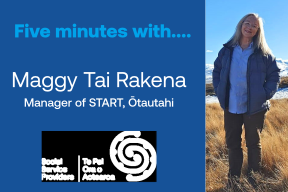
5 mins with Maggy Tai Rakena
Kia ora Maggy – can you tell me about what you do?
I’m the manager of START, which is a little NGO in Ōtautahi. We specialise in working with all ages of people including children, youth, and adults, who have experienced sexual violence. We provide early intervention, social work, advocacy, longer-term counselling, court support, prevention and other sexual violence related education. I've been doing this mahi for more than 30 years and I had an earlier work life in early childhood education.
What prompted the change of career direction?
This was never a plan, more a series of opportunities, which I understand from research is how women’s careers often evolve. I was involved in the first iteration of school boards of trustees in 1989 and I learnt a lot about governance. I did that for 15 years and during that time I got recruited to also take on a governance role at START.
After a restructure, I was then asked to take on a management role. I didn’t think for one minute I was capable of it. So, I did it for a little while, thinking I was just holding the fort until the ‘real person’ came along. But two years later my supervisor challenged me to recognise it was in fact my role and I needed to come to grips with that. So, I took on some more learning and ended up subsequently becoming a registered social worker, alongside doing other training in counselling, community psychological care, leadership, and management including a graduate diploma in Not-for-Profit Management.
What has kept you inspired over your 30 years in the sector?
I’m inspired by people who have experienced sexual violence being brave and courageous. The courage it takes for people to come towards healing very painful experiences is, to me, always remarkable. It’s very motivating because we’re not here for ourselves, we’re here for the people we serve. I’m also strongly motivated by matters of justice.
What are your reflections on the social service sector over the last three decades?
My observation is that the public don’t have a good understanding about the process of change and healing and how complex these things frequently are. People want simplistic and rapid responses to complexity. Turning around generations of harm in particular is very complex. Dysfunctional behaviours can become functional, but they often need trainer wheels alongside for quite some time until those new behaviours are securely in place. Quick fixes aren’t generally the answer.
What has been your greatest professional challenge?
There are so many things to do and there isn’t enough time or resources to do them all. There are usually many possibilities when working with people, and so the challenge is to try and ensure that you select the right thing to do at the right time. Often, I’m asking myself, did I choose the right things to do with the limited time I’ve got? And you never really know. But you do it with the best knowledge you’ve got in the moment.
Do you think that innovations in technology can help with that workload?
I do use various technologies, and I love what they give me, but I can see there can be considerable risks in their use. It takes time, that not many of us have, to learn how to use technologies safely. The younger people coming through are digital natives who are up and ready to run with technology. We need to have a bridge between that new learning and the old learning because they’re both important.
What has been your greatest joy professionally?
It’s seeing people change, seeing them healing and doing better. Recently a young person who came here around 10 years ago popped in for a spontaneous visit. We aim to provide a community of care here and such visits evidence we have. That is a joy for me. It’s the fact that you have a window, an opportunity with someone to work at their pace. You might not get all the work done but you can create a platform for people to return to services if needed.
In this election year, what is one thing politicians could do to improve the lives of people that you serve?
Politicians need to understand their local NGO services and what they do. They should actually go visit – not just read a brochure because I repeatedly hear people in positions of power demonstrate they misunderstand how people get the help they need. They want short-term solutions in unrealistic timeframes. Healthy change can be slow, complex work and for some people you need to be around for a good while.
Political leaders need to give us confidence that this work is going to be predictably and sustainably funded. It really frustrates me to think about how much of the ‘social service dollar’ is spent getting the ‘social service dollar’. There’s so much time, money and effort spent keeping the ship afloat seeking funding and furnishing accountabilities that could be far better spent on the frontline delivery of services.
You were a board member of Te Pai Ora SSPA in the early days. What value do you think our organisation has for the sector?
Most NGOs in the social service sector are small and so you need to be able to connect with other people locally and across the country to learn from them, share ideas, keep up to date with research and all the learning that goes on to be a good social service. Te Pai Ora SSPA offers collegiality, learning and collective advocacy at a national level. There’s a lot of inconsistency around the country, so it gives you some opportunities for cohesion.